Sunday, November 1, 2009

Tropicalissmo! (sort of)


Over at Danger Garden, Loree recently invited her reader/bloggers to join her in posting a then-and-now retrospective of their garden progress. I loved the idea, so my next few posts will focus on areas of our back garden that have undergone transformation since we moved in in 2007.

Today, our "tropical" area.

To set the scene, see the picture above (looking south): our backyard is a flat-sided hourglass, with larger areas north and south, and a narrow neck in the middle. The entire backyard was circumscribed by a four-foot chain link fence with gray slats. You can see the grassy bowling alley we inherited from the previous homeowners in 2007.

We decided the northern part would be Ben's Northwest native area, our southern part would be my Mediterranean and xeric area and we'd have a small tropical middle where it was limited in size and easy to keep watered.

We spent the winter following our purchase of the house planning a complete re-do of the backyard. As much as we hated the chain link, it would have been prohibitively expensive to replace its nearly 200 running feet with something we liked better. Above, looking north, using buckets and pots to plan the location of trees.

March 2008: We yanked the plastic vanes out and painted the fence black to help it go away visually.

April 2008: The landscape crew removed grass and quite a lot of concrete walkway up next to the house.

More soil has been brought in and the new beds are amended.

May 2008: I have just planted bamboo along the fence in the tropical area. I posted earlier about the bamboo barrier and planting here.

September 2008: In a surprise move, we added back some sod(!) The plan is to bump out the bed on the left and still have a walkway to the north area.

A shot of the bamboo, which was filling in nicely by September.

The same area, but from the north.

December 24, 2008: Amazingly, the bamboo bounced right back after the snow and ice melted.

Spring 2009: The fatsia japonica and some callas I transplanted from the front of the house are doing their spring thing.

May 2009: these may be common callas, but they are beautiful, healthy, and add a wonderful tropical note to the garden.

June 21, 2009: George and Martha came to the tropics for Fathers Day. The assorted cannas are finally leafing out.

July 2009: the bamboo is filling in more.

Later that summer, a musa basjoo joined the group. In hindsight, I see I should have planted it further away from the house.

October 2009: The banana is getting bigger, but behind it the bed has become a bit of a catch-all for the plants I didn't immediately have another place for, like a cinnamon-colored chrysanthemum and some hemerocallis Stella d'Oro. But on the right, huge colocasia leaves are a wonderful accent.

Have we achieved tropicalissmo? I need more ground-level plants, and the bump out isn't done yet, but I think we're getting there. I also need to get the inappropriate plants out of the beds and replace them with more tropical-feeling selections. One irony is that some of the largest-leaved plants have ended up with the smallest footprint to call their own. I have a feeling we'll be expanding the tropical area southward in future years.

Monday, October 26, 2009

Random autumn images

From a walk up Marquam Hill, some glistening mushrooms.

The same walk, a web so finely woven that it held dewdrops .

A fat spider in my back garden.

A fiery Japanese maple in Ladd's Addition.

The Meyer lemon, inside for the winter. Some of the fruit looks perfect, but should I harvest it?

Danish squash from the garden.

Late afternoon sunlight through the Karl Foerster feather reed grasses. I can't clean up the spent sunflowers yet: gold finches and chickadees are coming daily to eat the ripe seeds.

A juvenile Japanese maple I rescued as a seedling, sporting its fall foliage.

My dwarf pomegranite, with bright golden leaves.

Once I get over mourning summer, I see how beautiful autumn can be.

Monday, October 12, 2009

Plant ceanothus and stand back!


I have always loved ceanothus. It's one of those easy, evergreen Northwest native plants that looks good in almost any garden. We had a lovely deep-blue flowered one at our previous home, and I was determined to have one at this house, too. Maybe more than one. After all, I had a lot of ugliness to cover, and ceanothus is a fast grower.

Above is a view of the butt-ugly CMU wall that retains the back garden from the sidewalk along our south property line. This shot was taken the first summer we were in the house - in 2007. We hadn't yet done any landscaping, so what you see is what was there when we moved in. Note the overgrown shrub barrier obscuring the windows of the house.

Nothing has changed in this shot from early spring 2008, except there's a small ceanothus thyrsiflorus 'Victoria' I planted the previous fall located dead center on the wall, and all the plastic vanes have been pulled out of the chain link fence.

About a month later: all the big overgrown shrubs have been removed around the house to reveal the brick chimney and narrow planter boxes. Landscape work hasn't begun yet, but will as soon as the fence is painted black. The ceanothus bides its time, but only briefly.

Late summer, 2008: all the basic backgarden landscaping is complete. Parthenocissis tricuspidata and a clematis armandii are helping the significantly bigger ceanothus begin to cover the wall. Harder to see in this picture is a second ceanothus planted in the back garden near the fence. The idea (and it does seem to be working) was to minimize the fence by letting the two ceanothus grow together through the fence.

Summer 2009: A new bed anchored by the much larger ceanothus has been carved out of the front lawn. The back garden ceanothus has also grown bigger and is blurring the fence further. Both have at least doubled in size from a year ago. Did I mention these shrubs are fast growers?

Ceanothus thyrsiflorus 'Victoria' is one of the larger ceanothus varieties and could easily reach 12 feet. I'm cheering it on! I understand that they don't have especially long lives, but I hope mine keep softening and disguising the fence for a good number of years. Not to mention attracting me and the bees with their frothy blue blossoms in spring. There's a reason they're called California lilacs.

"But wait a minute." I hear you saying, "where are all the pictures of those aforementioned frothy blossoms?" Well, believe it or not, I can't dredge up a single picture of my own ceanothus in bloom. Pretty sad for a garden blogger, right?


But here's a ceanothus from an early spring walk in Southeast Portland this year. This shrub was so covered with bees it practically vibrated. And next spring, I'll remember to take pictures of my own ceanothus when they're in bloom. It's the least I can do for one of my favorite natives.

Sunday, October 11, 2009

Happy plants


The Mulchmaid has been enjoying unmistakable signs of plant happiness this fall.

Both the fatsia japonicas have added a foot or two all around this year. And they are blooming for the first time with these white blossoms that look oddly prehistoric. They're weird, but I kind of like them.

A mystery plant germinated and grew to about 18 inches this summer. I want to believe it's an arbutus menziesii seedling, but I'm unconvinced it's not just a photinia. If it is a. menziesii, it's a sign that one is needed in the Northwest Territory. Stay tuned for the further adventures of Mystery Plant.

Over a year ago, a coworker gave me two opuntia paddles wrapped in paper towels inside a paper bag. I tucked the bag on a shelf last autumn, and promptly forgot about it. Early this summer, the bag came to light. Dang! I figured they were goners, but I half-buried the yellow, dessicated things in a couple of pots and waited.

Yes, one was truly dead. But the other sent out two stringy shoots that looked nothing like prickly pear paddles. Gradually, the paddle supporting the shoots rotted, so a re-planting was needed, burying the remains of the paddle completely. Above you can see the results. This is not exactly a success story yet, but it's quite a testimonial to the life force of opuntia. We'll see what next year brings.

One of the strongest signs of happy plants is the number of seedlings I've found of plants that never re-seeded in my gardening past. Above is a two year mahonia nervosa, and below is a tiny seedling from it.


Along the street is a rose bed that was planted by the previous owners. I've posted before about my lack of commitment to hybrid tea roses. I planted some herbs for diversity and winter interest, and they are loving the location enough to reseed. Above, the parent lavender, and below, a seedling lavender.


A rosemary of no particular variety has reseeded as well. We have happy plants!


Last, my agave scabra has grown significantly over summer. I think it has doubled in size.

And yesterday I discovered what has to be its pup! But I didn't move this one from its mother's side.

Look at the distance between the plants: the pup is a foot away from the mother plant. How can this be? I thought a. scabra would spread by offsets, not by rhizomes or runners. It hasn't bloomed, so somebody please explain this to me!

Monday, October 5, 2009

A mass of grass

There's an interesting open space between two newer buildings on 4th Avenue in downtown Portland. To the north is the city's 1900 Building, shared space between the City of Portland and PSU, so it houses both the Bureau of Development Services and PSU classrooms.

To the south, the plaza was developed when a new PSU computer science facility was built several years ago. The design is spare, with linear concrete planters and simple seats as part of the planters. In winter it's almost bleak, and in summer the plaza really cooks in the sun.

There are only a few small trees along the sidewalk, so whatever went into those planters needed to be very heat tolerant.


Although I'm not a big fan of single-species plantings, I think this grassy solution is both appropriate and beautiful. I don't know many grasses, so I won't hazard a guess as to the species. Ideas, anyone?

The grasses are in almost constant motion due to the air currents between the buildings. The waving plumes and sheer size of the planting makes me think about how the Great Plains might once have looked.

Wednesday, September 30, 2009

Color or form?

How about threads? I love the thready spikes this agave filifera wears. I tried to separate the pup next to its mama, but it didn't want to come loose, and I was afraid to force it. Maybe when I get more experience with agaves I'll feel braver about trying again.

Here's a filifera pup that was growing inside the pot, scrunched up next to the plastic. It's making a very slow recovery since I liberated it. I hope it will eventually open out a bit more than it has over the past two months.

Speaking of pups, here's a lovely agave Americana pup, courtesy of the danger garden. It is putting the baby filifera to shame, growth-wise, having put on several new leaves. I love its great combination of both form and color, with its open rosette shape and its sleek stripes of cream down each leaf edge.

Now we have perfection, in both form and subtle color. This is probably my favorite agave, so far. Agave parryi var. truncata has it all. Can you believe that rosette?

And how about those perfect red thorns and terminal spikes?

Eucalyptus debeuzevillei has lovely gray-green color on its side, but I'm pretty happy with its form this year, too. It added at least four feet over summer. You can see how much higher than the fence it has grown.

The leaves of this ficus carica Negronne have beautiful, long, deep green fingers. It's hard to see how Adam and Eve could have used leaves like that for modesty. But this fig has also grown about four feet this summer, so I'm thrilled, even though its form is pretty rangy. It even has a few figs on it!

I hope you can see how this carex flagellifera 'Toffee Twist" is developing the most delicious coral color on some of its leaves (stems?) this fall.

And the pink in my phormium "Pink Stripe" has deepened so that it's becoming more of a magenta. Along with the gray-green leaves, it's a wonderful contrast.

The Meyer lemon, sitting out in the garden for the summer, is surrounded by toffee twist carex and sage. The lemon leaves are such a bright green by comparison. It's not a tree I would grow for its form, but the lemons ripening on it and its fragrant indoor blossoms through winter let me forgive its slightly ungainly shape.

Here's a final contrast: Agastache 'Acapulco Orange', helichrysum italicum microphyllum and toffee twist carex. I love the way the gray curry plant makes the other two look so rich. Color wins in this graceful grouping.

Wednesday, September 23, 2009

This is not a plant.

At lunch time yesterday I visited Pioneer Square, here in Portland. As I arrived, a public relations event was just concluding. And I couldn't see the object of all the excitement until I walked over and entered the crowd:


This amazing little vehicle is all-electric and gets an estimated 190 MPGe (miles per gallon equivalent). It has a top speed of 55 MPH ... and does it using only three wheels.

The Pulse is made by Eugene, Ore., company Archimoto, and it will be available in 2010.


The MulchMaid wants to plug one in!

Monday, September 21, 2009

Nursery loot

This summer I've filled up my extra garden bed space with a mixture of vegetables, and annuals like sunflowers. But when harvest is done, I know there will be some holes in the garden. So I've been on a modest plant-buying binge.

While my brother was visiting from Pennsylvania, we went to Cistus and I acquired its namesake above: Cistus x obtusifolia. The tag says "masses of white flowers." Sounds good to me.

I also picked up a little Delosperma congesta 'Gold Nugget', but with no flowers on it it looks just like any little triangular sedum.

Being unable to resist most things in the manzanita family, I fell for arctostaphylos x Martha Ewan, above, at Cistus. She's a little smaller and better sized for the spot where I planted her larger cousin, arctostaphylos Austin Griffiths. I'll move him and put her in his place.

I stopped in at Pomarius for the first time last Friday and had a nice time looking at all the offerings. Since I wasn't going home and I didn't want lots of plants baking in the hot car, I confined myself to just one plant - this sweet little Lewisia cotyledon. It would look great in our native alpine area, but will probably end up in the south bed.


Last, but certainly not least, I hit the Hardy Plant Society fall sale. I think I showed remarkable restraint in only buying three plants. Above, Eucomis comosa 'Oakhurst'. I'm not quite sure where this should go yet, but after seeing the gorgeous eucomis at Danger Garden, I had to have at least one.

I went to the HPSO sale looking for Luzula of any kind, but no luck there. I found a few growers that have them at their nurseries, though. Instead, I ended up with two Carex morrowii 'Evergold' to brighten up my front porch this winter.

Now I'll just be patient (maybe) while the vegetables finish out the season, and the weather cools down enough for planting all this loot.

Sunday, September 13, 2009

Pittock Mansion perennials - a Saturday walk

I've posted before about weekend walks I take in the Portland area. I usually find something a little more offbeat to post about than your standard, lovely perennial plantings. But Saturday, it was just such plantings that delighted me at Pittock Mansion, after we'd hiked up the wildwood trail from Macleay Park.

It was a warm day, so we started early. We hiked in the shade, but by the time we reached the top, the sun was hot and the plants were loving it. Above, Rhododendron Yak Van Zile. I like the fuzzy leaves with their warm brown undersides.


They grow a fair number of roses with simple, often very small blossoms. Not all are marked, but the white one above is a shrub rose, Cliffs of Dover.


Beautiful, but an unnamed mystery rose.

The terrace of Pittock Mansion is a favorite location for bridal party photos. Interestingly, they always seem to speak Russian or another Slavic language. Of course the brides are always beautiful!

This is Darlow's Enigma. I was interested to see the mature plant, below, since I just planted one in my garden this summer to help cover the chain link fence. Now I'm not sure it's up to the task, but I'll give it a chance anyway.


In the shady circular bed near the entrance, there were some nice hosta selections. Above, Francee, and below, Lake Port Blue. I was impressed at the intact condition of the leaves. They obviously have any slug problems licked.


I guess no one has told the gardeners that English Ivy is a menace, but the ivy is also supporting some other kind of smaller vine that is the majority of what you can see in the picture. The effect looks like my idea of what the Hanging Gardens of Babylon might be like.

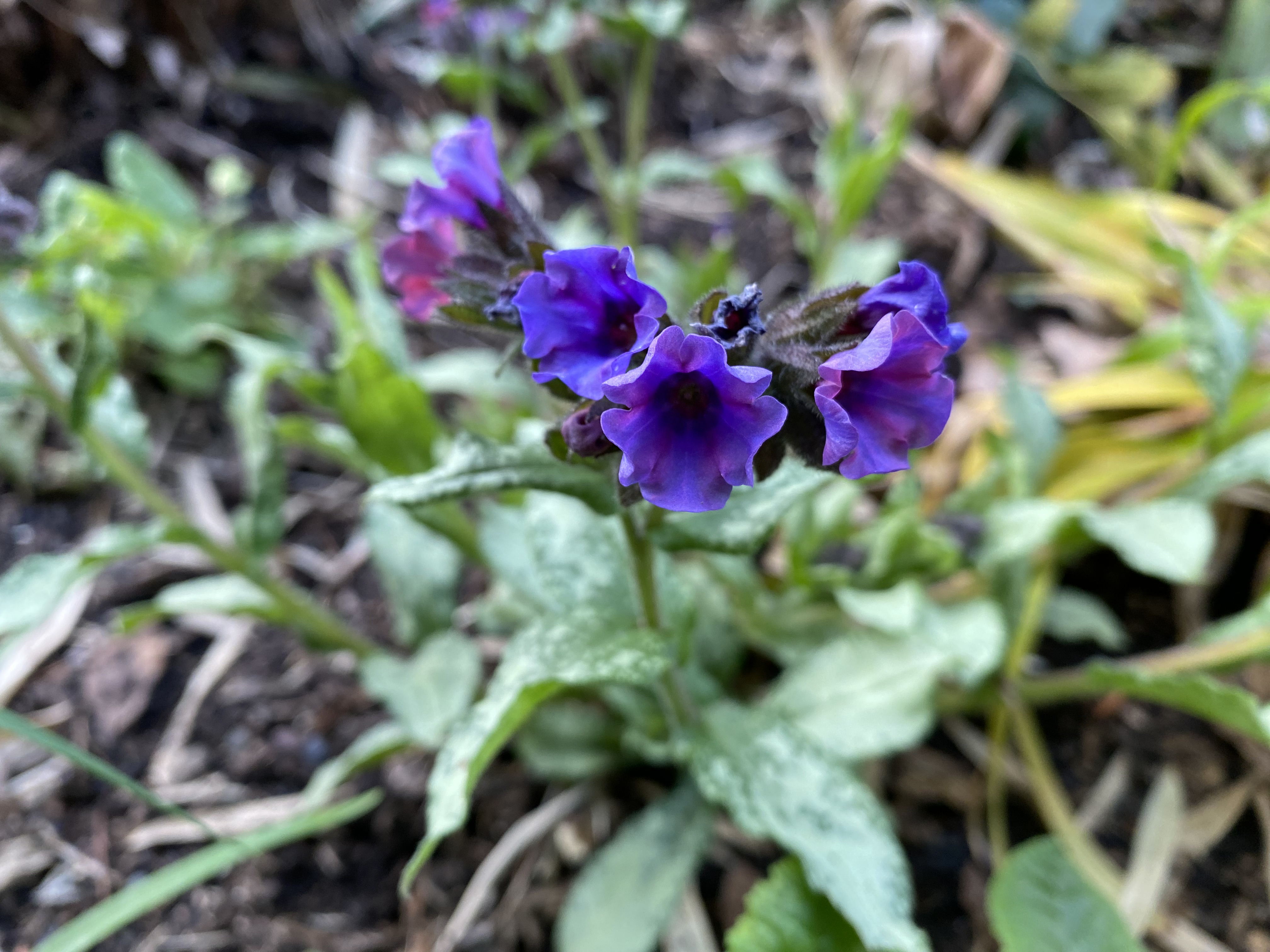
There was a bed of wonderful Pulmonaria selections in fairly deep shade. I haven't previously been too impressed with Pulmonaria, but these nice specimens grouped together were quite an eye-opener.


Unfortunately, only one was marked: the spotted one on the left above is Pulmonaria saccarata Mrs. Moon.

This beautiful tree, just barely beginning to turn color is Acer palmatum Sango Kaku. This particular tree is one of my favorite specimens.

After our walk we went to Hoda's on Belmont for a Middle Eastern lunch. The Belmont Street Fair was in full swing, with music, crafts and food.

They even brought in grass and some red-twig dogwoods, along with chairs and an umbrella to make a little park right in the intersection of Belmont and 34th! Fairgoers were putting it to perfect use in the bright Saturday sun.

Friday, September 4, 2009

A beautiful metal retaining wall

Neighbors across the street from friends in the Richmond neighborhood installed a new steel retaining wall early this year. Their lot is on the northeast corner of an intersection, and both sides of the sloped front yard had been covered by that type of no-maintenance juniper planting you see all over Portland. You know, the ones that always smell like cat pee.

The homeowners designed the wall themselves, then had it fabricated. They had weep-holes cut into the metal, and backed them with screening. The wall is installed on heavy-duty footings, as you can imagine.

Once the soil was backfilled they started landscaping this spring. They used lots of Mediterranean and drought-tolerant plants and shrubs: with just one summer's growth, the results are spectacular.

The steel is slowly gaining a nice patina. It's an amazing improvement, and a beautiful solution to retaining the garden slope.

I really like the way the modern lines of the wall complement their attractive midcentury ranch/bungalow. As nice as it already is, it'll be even more interesting as their garden matures around it over the next few years.